The China syndrome as extended soundscapes
Julkaistu 19.7.2009 10:07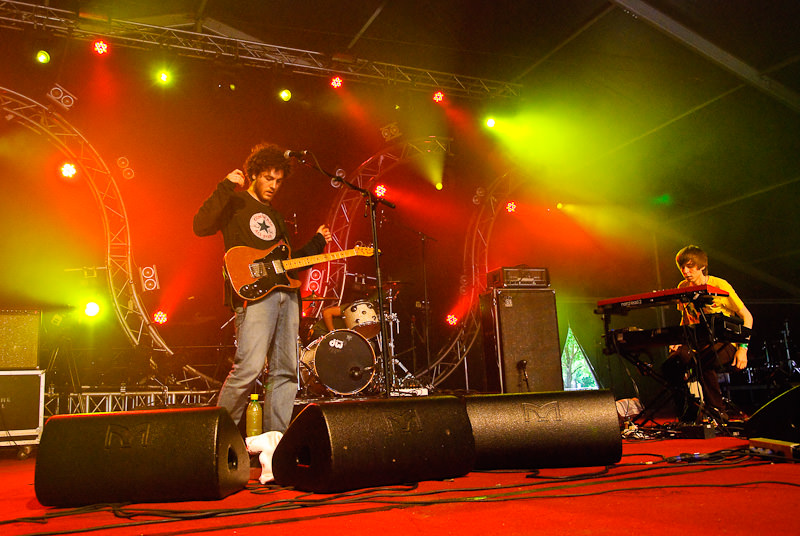
Whenever Ilosaarirock has guests from beyond the eastern border, they always carry a surprising element in their music. Whether it’s about the unique rhythms of Tequilajazzz, the laid-back latin grooves of Markschneider Kunst or the Karelian ethnic rock of Santtu Karhu, the performances of Russian artists have always had their unique flair which has separated them from the masses. Unlike their countrymen, Everything is Made in China, who hail from Moscow, had decided to challenge the friends of indie music with their own weapons. Instead of slavic echoes or twisted grooves, the group offered a package paying respect to North American alternative groups, where large soundscapes hold a greater degree of importance than the geographic origin of the music.
Supported by cheery background video projections and some machine influences, the trio relied on their ability to paint open spaces. The structure of the performance was built on slowly developing and deeply affecting songs, where melodies were long and carefully planned rather than cunning or surprising. Most of the wall of sound was built on the dreamy keyboard melodies played by Prem’yak Filipp and the concentrated guitar-playing of Fedorov Maksim, and complemented by Zotov Aleksey’s clockwork-precision drumming. In the middle of this massive wall of sound was Maksim’s almost shy voice, which seemed to introduce a human aspect to the mountain-sized tapestry of sound.
Beforehand the group was compared to such contemporaries as Mew and Mogwai, which wasn’t an completely unfounded assessment, but the symphatetic group was able to deliver their own unique aspect with their songs. When the time for the encores came, the trio had already won the hearts of the audience at the third stage.
Text: Hannu Linkola
Translation: Juha Ekholm